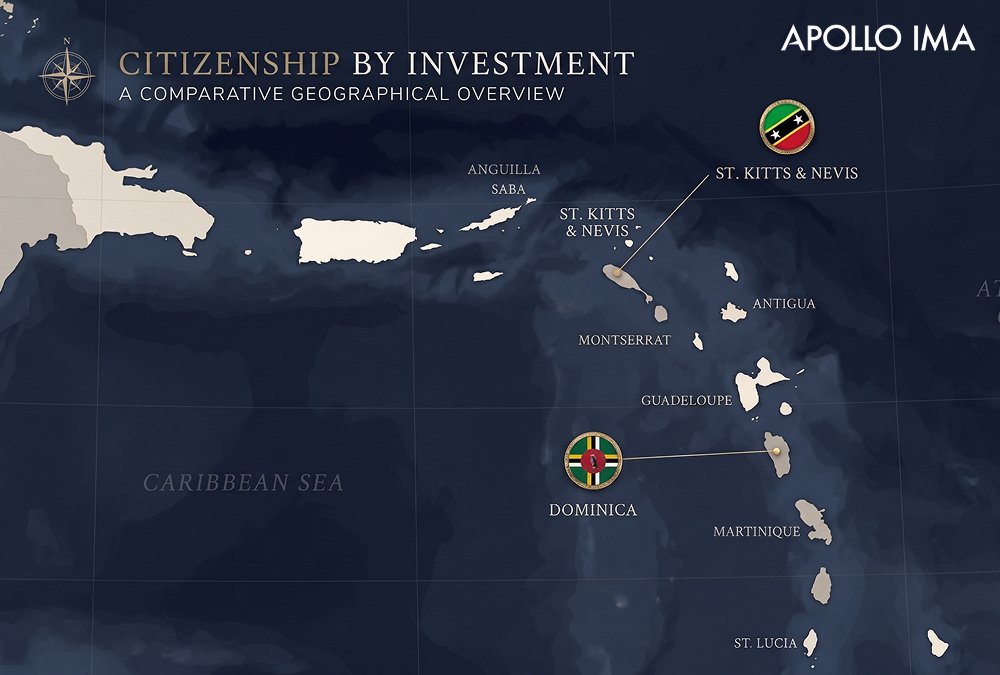
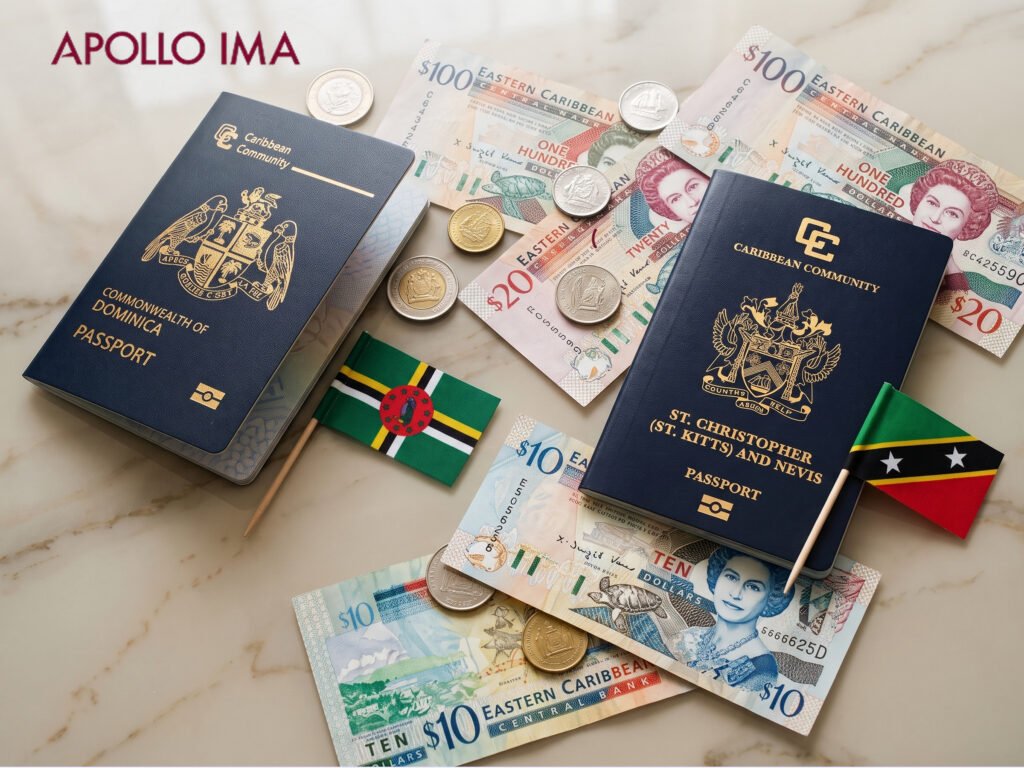
Dominica and St Kitts and Nevis are the two Caribbean CBI program people compare first. Both lead to full citizenship and a second passport. Both have no residency requirement and allow dual citizenship. The price is usually what separates them.
This guide is for adults weighing a second passport who want real numbers. It uses the figures published on Apollo IMA’s Dominica citizenship by investment program and St Kitts and Nevis citizenship by investment program pages. It covers the headline investment, government fees, family totals, and the real estate route. These are citizenship programs, not residency permits.
Which Caribbean citizenship program is more affordable?
Dominica is cheaper than St Kitts and Nevis. A single applicant pays from US$200,000 in Dominica and from US$250,000 in St Kitts, before fees. With government and due diligence fees included, the gap is about US$50,000 for one person. For a family of four, it shrinks to about US$4,000.
Dominica vs St Kitts citizenship cost: the headline numbers
Each program offers a contribution route and a real estate route. St Kitts adds a third option: an approved public benefit project, also at US$250,000.
In Dominica, the contribution goes to the Economic Diversification Fund (EDF). In St Kitts, it goes to the Sustainable Island State Contribution (SISC). Both are non-refundable.
| Dominica | St Kitts and Nevis | |
| Program launched | 1993 | 1984 |
| Contribution, single applicant | US$200,000 (EDF) | US$250,000 (SISC) |
| Contribution, family of four | US$250,000 | US$250,000 |
| Extra dependent under 18 | US$25,000 | US$25,000 |
| Extra dependent 18 or over | US$40,000 | US$50,000 |
| Real estate minimum | US$220,000 | US$325,000 (US$600,000 for a single-family home) |
| Real estate holding period | 3 years (5 years to resell to a new applicant) | 7 years, under certain conditions |
| Visa-free access | 135+ countries | 145+ countries |
| Processing time | 5 to 8 months | As little as 60 days (about 4 to 6 months overall) |
| Residency requirement | None | None |
Two points stand out. The single-applicant contribution is US$50,000 lower in Dominica. But the family-of-four contribution is the same in both programs. The government contribution requirements only diverge when you add adult dependents or choose real estate.
Government fees and due diligence requirements
The qualifying investment is only part of the bill. Both programs also charge government processing fees and due diligence fees. These citizenship investment fees decide how close the two programs really are.
Due diligence requirements are strict in both. Every adult applicant is vetted. Dominica holds an online interview with the main applicant and family. St Kitts interviews applicants aged 16 and over and dependents aged 16 and over where needed.
| Fee | Dominica | St Kitts and Nevis |
| Due diligence, main applicant | US$7,500 | US$10,000 |
| Due diligence, spouse | US$4,000 | US$7,500 |
| Due diligence, dependent aged 16+ | US$4,000 | US$7,500 |
| Application fee | US$1,000 per application | Not listed |
| Interview fee | US$1,000 per application | Not listed |
| Government real estate fee, single applicant | US$75,000 | US$25,000 |
| Government real estate fee, family of four | US$100,000 | US$60,000 (calculated) |
The St Kitts family figure is calculated from the published rates: US$25,000 for the main applicant, US$15,000 for the spouse, and US$10,000 for each child under 18.
On the contribution route, only due diligence and administrative fees apply. The real estate route adds the government real estate fees. These are much higher in Dominica, but the lower property minimum still keeps Dominica ahead on total cost.
Total cost by scenario
This Dominica vs St Kitts citizenship cost comparison adds the investment, due diligence fees, application and interview fees, and government real estate fees from the tables above.
| Scenario | Dominica | St Kitts and Nevis | Difference |
| Single applicant, contribution | US$209,500 | US$260,000 | US$50,500 |
| Family of four, contribution | US$263,500 | US$267,500 | US$4,000 |
| Family of four plus one dependent parent, contribution | US$307,500 | US$325,000 | US$17,500 |
| Single applicant, real estate | US$304,500 | US$360,000 | US$55,500 |
| Family of four, real estate | US$333,500 | US$402,500 | US$69,000 |
A few assumptions apply:
- The children in the family-of-four examples are under 16, so no due diligence fee is charged for them.
- The dependent parent is aged 18 or over and is charged as an adult dependent.
- Totals exclude advisory fees, legal and certification costs, document costs, and property purchase costs.
Apollo IMA’s program pages say these extra costs depend on the application. A written quotation is the only way to get a final figure.
What the numbers show:
- Single applicants save the most in Dominica.
- Families of four with young children save very little.
- Adult dependents widen the gap.
- The real estate route widens it the most.
The real estate route: lower cost versus an asset
Both programs let you invest in approved real estate instead of contributing. The upfront cost is higher, but you hold a property.
In Dominica, the minimum is US$220,000. You must hold the property for three years before selling on the open market. After five years, you can also sell it to a new citizenship applicant.
In St Kitts, the minimum is US$325,000 for an approved development or a condominium unit. A single-family private dwelling starts at US$600,000. The property can be resold after seven years under certain conditions.
Be realistic about what you get back. A resale price is not guaranteed, and the government fees are not recovered. Apollo IMA advises assessing any approved real estate investment on its own merits: location, developer record, and resale terms. The shorter holding period in Dominica is also a cost advantage, since your capital is tied up for less time.
Dominica vs St Kitts citizenship for families
Both programs let you include a spouse, children, and dependent parents in one application. The costs differ in three places:
- An extra dependent under 18 costs US$25,000 in both programs.
- An extra dependent aged 18 or over costs US$40,000 in Dominica and US$50,000 in St Kitts.
- The due diligence fee per dependent aged 16 or over is US$4,000 in Dominica and US$7,500 in St Kitts.
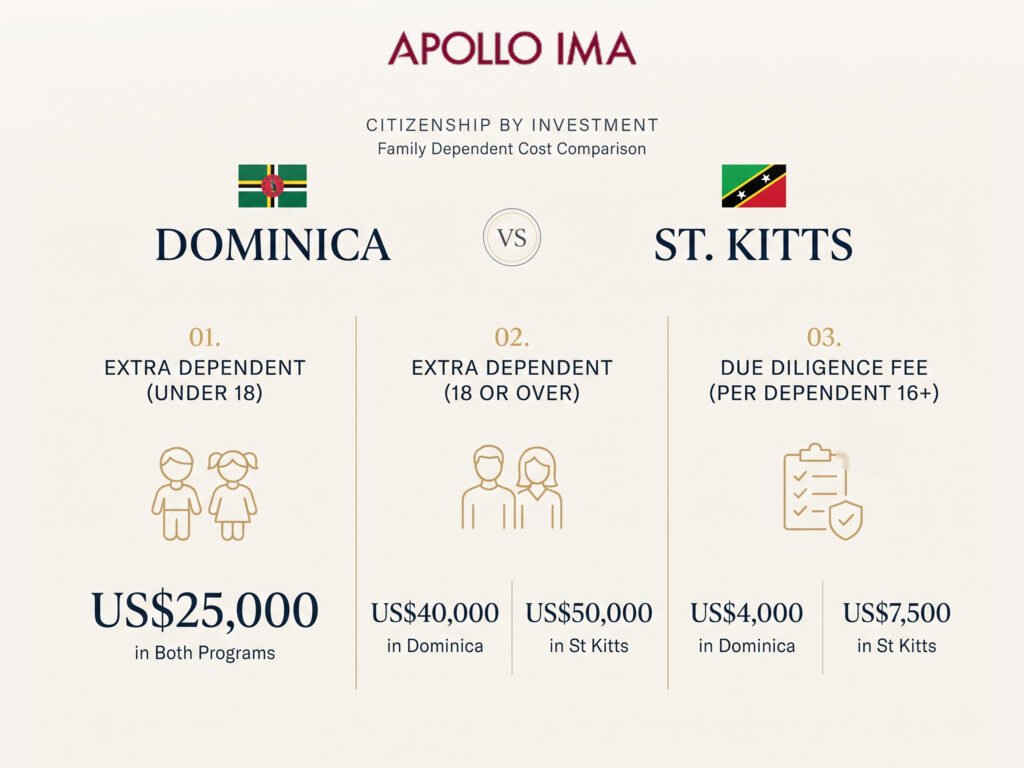
Family application expenses build up fastest when adults are included. If you are choosing the best Caribbean citizenship program for families that include parents or adult children, Dominica costs less. If your family is two parents and young children, the gap is small. Other factors can then decide the choice.
Dominica vs St Kitts citizenship differences beyond price
Dominica vs St Kitts passport benefits
St Kitts gives visa-free or visa-on-arrival access to 145+ countries. Dominica gives 135+. You can see the full destination breakdown in our guide to St Kitts and Nevis passport visa-free countries.
St Kitts also has the longest record. Its program started in 1984 and is the longest-running in the world. Dominica’s started in 1993. Both programs permit dual citizenship and have no residency requirement.
Eligibility and interviews
Dominica requires good character, a clean criminal record, excellent health, and a basic command of English. St Kitts puts every applicant, including adult dependents, through due diligence and background screening.
Processing time
Apollo IMA’s Dominica page gives a processing window of 5 to 8 months. The St Kitts page cites processing in as little as 60 days and about four to six months overall. Time has a cost too. A longer wait means a longer period without the passport you are paying for.
Affordable Caribbean second passport options
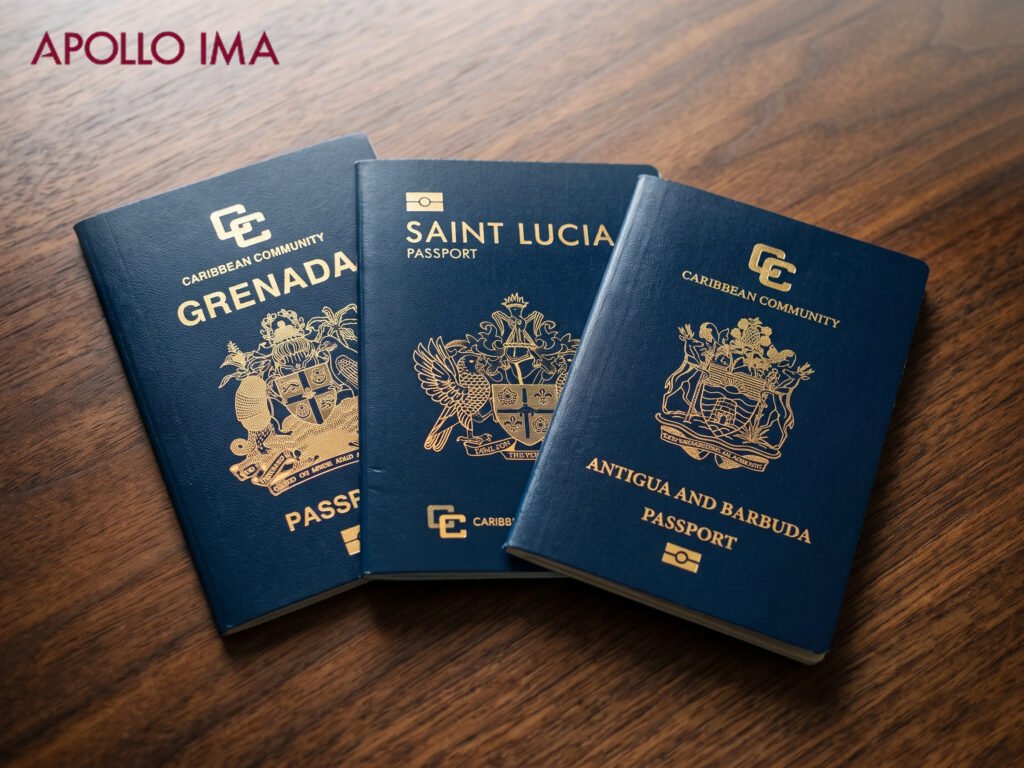
Dominica is the cheapest Caribbean citizenship by investment program on Apollo IMA’s list. The other programs sit between Dominica and St Kitts on entry price:
- Antigua and Barbuda: from US$230,000 through the National Development Fund
- Grenada: from US$235,000 through the National Transformation Fund
- Saint Lucia: from US$240,000 through the National Economic Fund
St Kitts, at US$250,000, is the highest of the five. Caribbean passport investment costs also differ by route, family size, and fees, so the headline number is only a starting point. For a wider view, read our Caribbean citizenship investment cost comparison. Or compare Caribbean citizenship investment options on our citizenship by investment programs page. These are all second passport investment options with no residency requirement, apart from a short stay in Antigua and Barbuda.
How to choose
- Lowest total cost: Dominica
- Adult dependents in the application: Dominica
- Widest visa-free access and longest track record: St Kitts and Nevis
- Fastest timeline on Apollo IMA’s pages: St Kitts and Nevis
- Family of four with young children: compare on mobility and timeline, since the price gap is about US$4,000
Apollo IMA is an independent global advisory firm covering citizenship by investment, residency by investment, international real estate and international company formation. For both programs, Apollo IMA assesses your family, compares the routes, prepares the due diligence file, and coordinates with the government unit through to passport issuance.
Read Also: Citizenship by Investment for US Citizens: 2026 Guide
Compare Dominica and St. Kitts citizenship packages with Apollo IMA.
Ready to apply for Caribbean citizenship through investment? Get a written quotation built around your family size and chosen route.
Frequently asked questions
Q1) Which Caribbean citizenship program is more affordable, Dominica or St Kitts?
Dominica. It starts at US$200,000, against US$250,000 for St Kitts. With fees included, the gap is about US$50,500 for a single applicant and US$4,000 for a family of four.
Q2) How much does Dominica citizenship cost for a family of four?
The contribution is US$250,000. With due diligence, application, and interview fees, the estimated total is about US$263,500 when the children are under 16. Advisory and other costs are extra.
Q3) How much does St Kitts citizenship cost for a family of four?
The contribution is US$250,000. With due diligence fees, the estimated total is about US$267,500 when the children are under 16. Advisory and other costs are extra.
Q4) Is the real estate route cheaper than the contribution route?
No. In both programs, the real estate route costs more upfront because of government real estate fees. You do hold a property, but resale value is not guaranteed.
Q5) Do Dominica and St Kitts require me to live there?
No. Neither program has a residency requirement before or after citizenship is granted.