Antigua and Barbuda has offered citizenship to investors since 2013. It is one of the lower-cost ways to get a second passport in the Caribbean. But 2026 is not a normal year for the program.
The European Union has asked Antigua and Barbuda to wind down its program, and the government has said it plans to do so. Even so, the unit that runs the program was still accepting applications in mid-November 2026. That mix of an open door and a ticking clock is why you need a clear plan before you spend any money.
This guide explains how the process works, what it costs, how long it takes, and what the latest news means for your decision. Apollo IMA, an advisory firm founded in 2017, helps investors compare citizenship and residency programs.
What Is Antigua and Barbuda Citizenship by Investment?
Antigua and Barbuda citizenship by investment lets you become a citizen by making a government-approved contribution or investment. You can contribute to the National Development Fund from US$230,000, buy approved real estate from US$300,000, give US$260,000 to the University of the West Indies Fund (families of six or more), or invest in a qualifying business from US$1.5 million. Citizenship lasts for life, passes to your children, and allows dual nationality.
Our Antigua and Barbuda citizenship program page lists visa-free access to 140+ destinations and a US$230,000 minimum. Both donation and real estate routes are available.
The Citizenship by Investment Unit (CIU) runs the program. You cannot apply on your own. Every application goes through a licensed agent, and the CIU reviews it.
What Changed in 2026 and Why It Matters
This is the part most guides skip, so read it before anything else.
On 17 November 2025, the Council of the EU gave final approval to tougher rules that let the EU suspend visa-free travel for countries that sell citizenship without a real link to the buyer. The rules came into force at the end of December 2025. In a letter dated 25 June 2026, the European Commission asked Antigua and Barbuda to phase out its program by 1 June 2028. The government made the letter public on 7 July 2026.
On 30 October 2026, the government wrote back. It said it is prepared to end the program but asked for a longer transition to the end of 2030, along with EU financial support. On 12 November, the CIU’s chief executive told stakeholders that the unit is still operating and accepting applications until further notice. As of 14 November, the Commission had not publicly replied.
Two more points belong here. The United States placed partial entry restrictions on Antigua and Barbuda nationals from 1 January 2026. These cover immigrant visas and visitor and student visas (B, F, M, and J), so check US rules if America matters to you. And on 13 November 2026, St Kitts and Nevis announced it will also wind down its program, on a timeline still being negotiated with the EU.
So what does this mean for you? You can still apply today. But no one can promise a closing date, and no one can promise how the passport’s Schengen access will look in 2028 or 2030. If Europe is your main reason for applying, weigh that risk honestly, and consider residency by investment in Europe instead. If you want a second passport for other travel, tax planning, or a backup plan, the case is easier to make.
Who Can Apply?
The main applicant
The main applicant must be an adult, over 18. You need a clean criminal record, good health, and proof that your money comes from legal sources. The CIU runs due diligence on every applicant aged 12 to 17, and it can refuse anyone, even if you pay in full.
Some nationalities face limits. People from certain countries, and people with strong ties to them, cannot apply. Ask your agent to check this on day one, before you pay any fees.
Your family
You can include your spouse, your children, and in some cases your parents and grandparents. Children up to age 30 can qualify if they depend on you, and parents or grandparents can join if they are 55 or older and depend on you.
Larger families should look at the University of the West Indies (UWI) Fund. It was built for families of six or more.
Four Ways to Qualify
National Development Fund (NDF) contribution
This is the most popular route. You make a one-time, non-refundable contribution of US$230,000. The contribution does not rise with family size, but government fees do. You do not buy anything, and there is no holding period. It is simple, and it is the cheapest way in.
Approved real estate
You buy a share or a unit in a government-approved project for at least US$300,000. You must hold it for five years before you can sell it. You get an asset back, but you also take on market risk, resale risk, and local legal costs. Apollo IMA’s investment-led approach looks at rental yield, appreciation, and exit options, not just the passport.
University of the West Indies Fund
Families of six or more can give US$260,000 to the UWI Fund. Like the NDF, this is a donation, and it includes a one-year tuition scholarship for one family member. For a family of six, compare it with the NDF plus the extra processing fees for the fifth and sixth dependents, because the totals can be close.
Business investment
This route starts at US$1.5 million for a sole investor. A joint investment can start at US$5 million, with each investor putting in at least US$400,000. It suits people who want to run or back a real business, and it is the most complex option.
What It Really Costs
The headline figure is only part of the bill. Here is what to expect on top of it. These numbers are estimates from public sources, so confirm each one with the CIU before you commit.
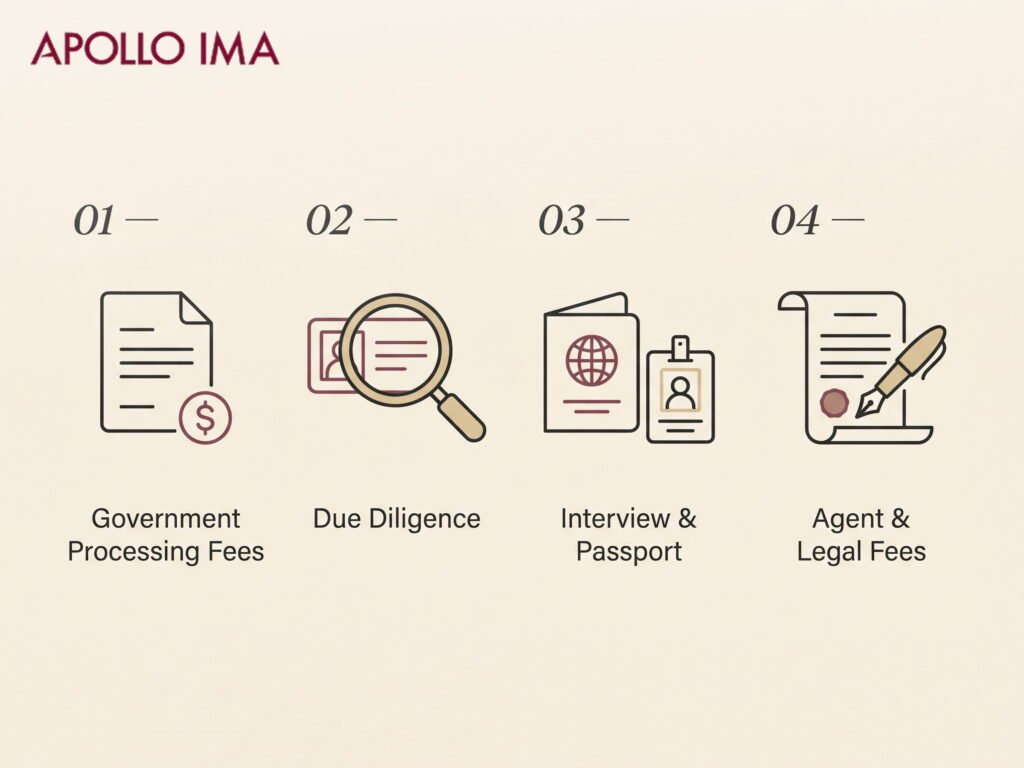
- Government processing fees: about US$10,000 for one person and US$20,000 for a family of up to four, plus US$10,000 for each extra dependent. Most sources apply these to every route, but some agents quote them as part of the NDF contribution, so ask for a written breakdown.
- Due diligence: about US$8,500 for the main applicant, US$5,000 for a spouse, US$2,000 for each child aged 12 to 17, and US$4,000 for each dependent aged over 18.
- Interview and passport: an interview fee of roughly US $1,500 for each person aged 16 or over and a passport fee of about US $300 per person.
- Agent and legal fees: these vary, so get a written quote.
How to Apply, Step by Step
The process is the same on every route, apart from the investment step.
- Pick your route and your agent. Choose between the NDF, real estate, the UWI Fund, or business. Use a licensed agent, because the CIU only accepts applications through them.
- Gather your documents. Expect passports, birth and marriage certificates, police certificates, bank statements, proof of source of funds, photos, and medical records. Certified copies are common.
- Submit the application. Your agent files it with the CIU and pays the due diligence fees and 10 percent of the processing fee.
- Wait for due diligence. The CIU checks your identity, background, and funds. The interview happens in this stage.
- Get approval and pay. Once approved in principle, you make your contribution or complete your property purchase.
- Take the oath and apply for the passport. You receive a certificate of registration. The passport application is a separate step, and you can take the oath at an Antigua and Barbuda consulate.
You do not need to live in Antigua and Barbuda or travel there to apply.
Benefits of an Antigua Passport
The main draw is mobility. Apollo IMA lists visa-free or visa-on-arrival access to 140+ destinations. That figure can change, so check it before you travel, especially for Schengen and the UK, which now needs an electronic travel authorization (ETA).
Tax is the second draw. Antigua and Barbuda does not charge personal income tax, and it has no capital gains, inheritance, or wealth tax. Citizenship does not mean you move your tax residence there, though. Your home country’s rules still apply, so speak to a tax adviser.
The country allows dual citizenship, so you can keep your first passport.
There is one rule you should not ignore. You must spend at least five days in Antigua and Barbuda during the first five years after you get citizenship. It is a short stay, but it is mandatory, and missing it can put your status at risk. Plan a trip early.
How to Choose the Right Route
Start with your goal. If you want the passport at the lowest cost, the NDF route usually wins. If you want some of your money back, real estate is the better fit, as long as you accept the five-year hold and the market risk.
Family size matters too. A family of four fits the NDF well. A family of six or more should compare the NDF and the UWI Fund. Business investment only makes sense if you plan to run the company.
Then think about timing. Because the program faces a wind-down, a slower route such as real estate carries more timing risk than a fast donation. If that risk feels too high, compare Antigua with our other citizenship by investment programs before you commit.
How Antigua Compares With Other Programs
Antigua and Barbuda is not the only option. St Kitts and Nevis runs the oldest program in the world, launched in 1984, and you can read the details on our St Kitts and Nevis citizenship. Remember that it is also heading toward a wind-down.
If you want a program outside the Caribbean, Türkiye citizenship by investment starts at US400,000 through realestate. Bank deposits, governmentbonds, and investment funds a real so accepted, from US500,000. Türkiye is not part of the EU’s Caribbean phase-out talks.
Final Thoughts
Antigua and Barbuda still offers a clear path to a second passport. The NDF contribution from US$230,000 is the cheapest entry, real estate gives you an asset, and the process can run without a visit.
But the program is on a path to closing. The EU wants it done by 1 June 2028, the government has asked for the end of 2030, and nothing is final. If you want this passport, do not wait for a perfect moment. Decide on your route, prepare your documents, and apply while the CIU is open.
Frequently Asked Questions
Q1) Is the Antigua and Barbuda citizenship by investment program still open?
Yes. On 12 November 2026, the CIU said it remains operational and is accepting applications until further notice. The government has also said it intends to wind the program down, so check the latest status before you apply. We track each update on the Apollo IMA blog.
Q2) How much does Antigua and Barbuda citizenship cost in 2026?
The NDF contribution starts at US230,000.Withgovernmentfees,asingleapplicantpaysaboutUS250,000. Real estate starts at US$300,000, and fees come on top.
Q3) Can I keep my current citizenship?
Yes. Antigua and Barbuda allows dual citizenship, so you do not have to give up your first passport. Check your home country’s rules, because some countries restrict dual nationality.
Q4) Do I have to live in Antigua and Barbuda?
No. You do not need to live there to apply. After you get citizenship, you must spend at least five days in the country within the first five years.
Q5) Will the passport keep its Schengen visa-free access?
Nobody can promise that. The EU asked for a wind-down by 1 June 2028 to protect Schengen access, and the government has asked for more time. Treat Schengen access as a benefit that could change.
Q6) Can my parents and children apply with me?
Yes, in most cases. Children up to age 30 can qualify if they depend on you, and parents or grandparents can join if they are 55 or older and depend on you. Each person adds fees and goes through due diligence.