
US citizens can hold a second citizenship. US law does not require you to choose, and the US Department of State says a US citizen can generally naturalize abroad without risking US citizenship. Second citizenship options for US citizens include citizenship by investment programs in the Caribbean and Türkiye, with Apollo IMA listing minimums from $200,000 to $400,000. Your US tax duties stay the same.
This guide explains how dual nationality works for Americans, which overseas citizenship programs exist, what they cost, and what foreign tax reporting involves. It also covers the USA EB-5 investor visa, because many Americans search for it and it works very differently.
Can US Citizens Hold Dual Nationality?
Yes. US law does not mention dual nationality or require you to choose one citizenship over another. According to the US Department of State, a US citizen may naturalize in a foreign state without risking US citizenship. Loss of citizenship requires a voluntary act done with the intention of giving up US nationality.

The Department of State also says the US recognizes dual nationality but does not encourage it as a matter of policy. Foreign citizenship laws apply to you once you hold that passport. Two rules matter in practice:
- You must use your US passport to enter and leave the United States.
- The other country may require you to use its passport on its own borders.
The US passport already opens many borders. So the dual nationality benefits for Americans usually sit elsewhere: more choice over where you live and work, a base for family planning, business access, and a fallback if conditions change. Apollo IMA describes a second passport as a way to reduce dependence on a single country’s policy shifts. Think of it as alternative citizenship for international mobility, not a travel upgrade.
Second Citizenship Options for US Citizens: Programs Compared
Citizenship by investment programs grant a second passport in return for a qualifying investment or contribution. Apollo IMA lists eight overseas citizenship programs. Here are the minimums it publishes:
| Programme | Starting From | Notes |
| Dominica | US$200,000 | Caribbean. A family of four starts from US$250,000. |
| Antigua and Barbuda | US$230,000 | Caribbean. |
| Grenada | US$235,000 | Caribbean. |
| St. Lucia | US$240,000 | Caribbean. |
| St. Kitts and Nevis | US$250,000 | Caribbean. |
| Türkiye | US$400,000 | Real estate route. Other routes start at US$500,000. No residency requirement. |
Nauru and Vanuatu also appear on Apollo IMA’s list. For a closer look at the Caribbean options, read the Caribbean citizenship by investment guide. Or review the individual pages for Dominica citizenship by investment, St Kitts and Nevis citizenship by investment, and the Turkey citizenship by investment program.
How to pick among the best citizenship by investment countries
The best citizenship by investment countries depend on your goals, not a single ranking. Compare these points:
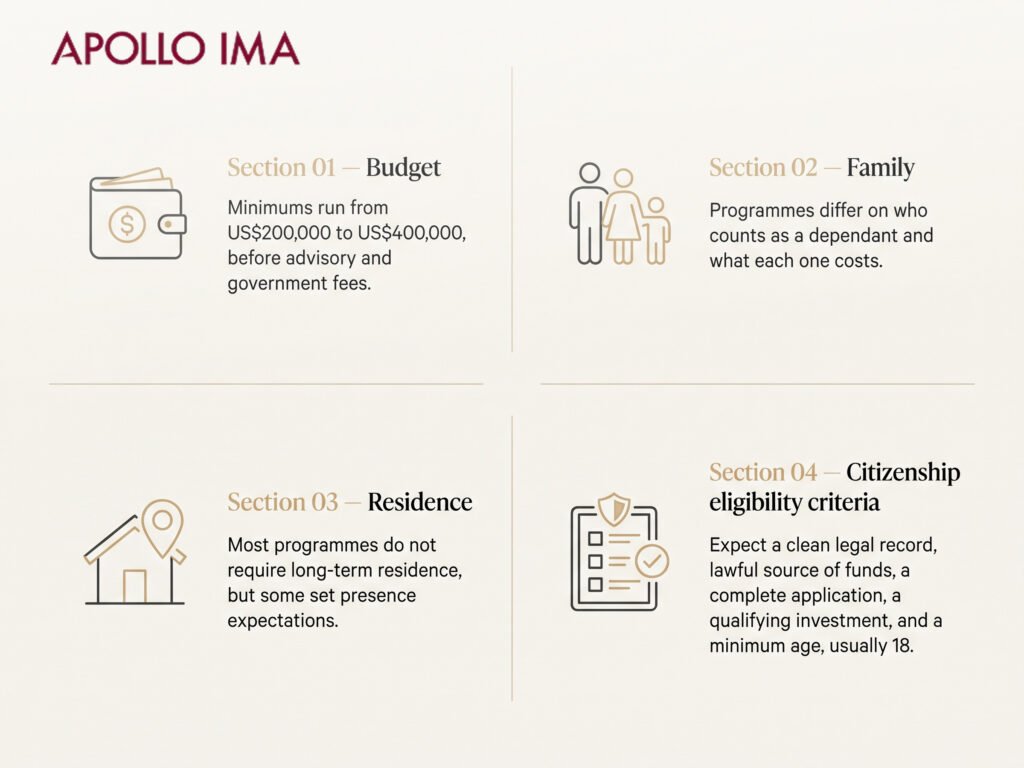
- Minimums run from US$200,000 to US$400,000, before advisory and government fees.
- Programs differ on who counts as a dependant and what each one costs.
- Most programs do not require long-term residence, but some set presence expectations.
- Citizenship eligibility criteria. Expect a clean legal record, lawful source of funds, a complete application, a qualifying investment, and a minimum age, usually 18.
Yes, US citizens can obtain a second citizenship by investment. US law does not require you to give up US citizenship, and the Department of State says citizens generally may naturalize abroad without risk. Apollo IMA lists programs from US$200,000 in Dominica to US$400,000 in Türkiye. Your US tax and reporting obligations continue.
Foreign Tax Reporting and Your US Obligations
A second passport does not end US tax duties. The US taxes its citizens on worldwide income wherever they live. Foreign tax reporting may also apply to accounts you open for your investment, such as FBAR and Form 8938 filings. Speak to a US tax adviser before you invest. This guide is general information, not tax or legal advice.
| Area | Effect of a Second Citizenship |
| US citizenship | Stays in place unless you voluntarily act with the intent to relinquish it. |
| US tax | Continues on worldwide income. |
| Foreign accounts | FBAR and FATCA reporting may apply. |
| Entering the US | Use your US passport. |
| Foreign obligations | Local rules apply. Check each country’s citizenship laws. |
Where Does the USA EB-5 Investor Visa Fit?
You do not need an EB-5 visa as a US citizen. The USA EB-5 investor visa is a route to a green card for foreign nationals. It matters to Americans in two cases: a spouse or relative who is not a US citizen or a client or partner comparing options. Searches for an investment visa in the USA or an American investment visa usually mean this program.

Apollo IMA describes US residency by investment through EB-5 as a route to a Green Card, created under the Immigration Act of 1990. Here are the EB-5 visa requirements and figures on its USA EB-5 programme page:
| Item | Apollo IMA Figure |
| EB-5 minimum investment (targeted employment area) | US$800,000 |
| EB-5 minimum investment (non-targeted area) | US$1,050,000 |
| Job creation | At least 10 full-time jobs for US workers |
| Processing time | About 18 months |
| First status | Two-year conditional Green Card |
| Family | Spouse and unmarried children under 21 |
| Citizenship route | May apply after five years of lawful residence |
Costs go beyond the investment. Plan for regional center, legal, and filing fees. To qualify, you also need a lawful source of funds and a sustained investment.
US Green Card investment reform
US Green Card investment reform is still moving. The EB-5 Reform and Integrity Act of 2022 set the current minimums and reauthorized the Regional Center program through 30 September 2027. Published summaries say the minimums adjust for inflation on 1 January 2027. A separate Gold Card, created by a September 2025 executive order, asks for a US$1 million gift. Check current rules with a US immigration attorney before you act. This is not a route for US citizens themselves.
Family Citizenship Rights
Family citizenship rights depend on the program. Dominica’s materials say citizenship is granted for life and can pass to future generations. The Türkiye program covers a spouse, children under 18, and dependent parents under one framework. EB-5 covers a spouse and unmarried children under 21. Ask how each option treats your children before you commit.
Read Also: Hungary Residency by Investment: 2026 Guide
Frequently Asked Questions
Q1) Can a US citizen get citizenship by investment?
Yes. US law does not require you to choose between US citizenship and another nationality. Check eligibility for the specific programme.
Q2) Will I lose my US citizenship?
Not by taking a second citizenship alone. Loss requires a voluntary act with the intention of giving up US nationality.
Q3) How much does citizenship by investment cost?
Apollo IMA lists programmes from US$200,000 in Dominica to US$400,000 in Türkiye, plus advisory and government fees.
Q4) Do I still pay US tax?
Yes. The US taxes citizens on worldwide income, and foreign tax reporting may apply. Get tax advice.
Q5) Is EB-5 for US citizens?
No. EB-5 is a Green Card route for foreign nationals. It may matter for a non-US spouse or relative.
Q6) What is the EB-5 minimum investment?
US$800,000 in a targeted employment area, or US$1,050,000 elsewhere, according to Apollo IMA.
Q7) How long does EB-5 take?
Apollo IMA lists about 18 months. Timelines vary, so ask for current figures.
Q8) Which are the best citizenship by investment countries?
It depends on budget, family size, and goals. Compare the programmes on Apollo IMA’s citizenship page.