
EU residency by investment lets a non-EU citizen get a residence permit in a European country by putting money into it. Most people call it a golden visa. It does not give you a passport. But it can give you the right to live in Europe and travel across the Schengen Area.
The rules look very different from three years ago. Spain closed its program in April 2025. Portugal dropped real estate. Greece raised its property thresholds. And Brussels is watching every scheme closely.
This guide explains how the programs work in 2026, what they cost, and how to pick one. The figures come from Apollo IMA, an independent advisory firm founded in 2017 that helps investors compare residency and citizenship programs.
What Is EU Residency by Investment?
EU residency by investment is a legal route where a non-EU national gets a residence permit by making a qualifying investment in an EU country. Options include property, funds, bonds, donations, or a business. The permit allows legal residence and usually visa-free Schengen travel for up to 90 days in any 180 days. It does not grant citizenship.
This is different from buying a second passport. A residence permit lets you live in the country. Citizenship is a separate application, and it usually needs many years of legal residence.
In April 2025, the EU Court of Justice ruled against Malta’s citizenship-for-investment scheme in a case brought by the European Commission. That closed the last passport-for-money program inside the EU. The ruling did not ban residence programs, and member states still run their own.
What Changed Before 2026
Several doors closed. Spain ended its golden visa on 3 April 2025. Ireland and the Netherlands had shut their programs earlier. Existing holders keep their permits, but new applicants cannot join.
Portugal removed real estate from its program. Investors now go through funds, company investments, or donations. Published legal summaries also say that most non-EU nationals now need 10 years of legal residence before applying for Portuguese citizenship, under the law that took effect on 19 May 2026. Apollo IMA’s Portugal page still lists five years, so confirm the current rule with your adviser.
Greece raised its property thresholds. The old €250,000 property entry now applies only to certain conversions and heritage restorations, plus a hotel or tourism lease route. Standard property purchases start at €400,000 or €800,000, depending on location.
As of spring 2026, no EU-wide law bans residence-by-investment schemes. But the Commission keeps pushing for stronger due diligence, so expect checks on your source of funds to stay tight.
The Main EU Programs in 2026
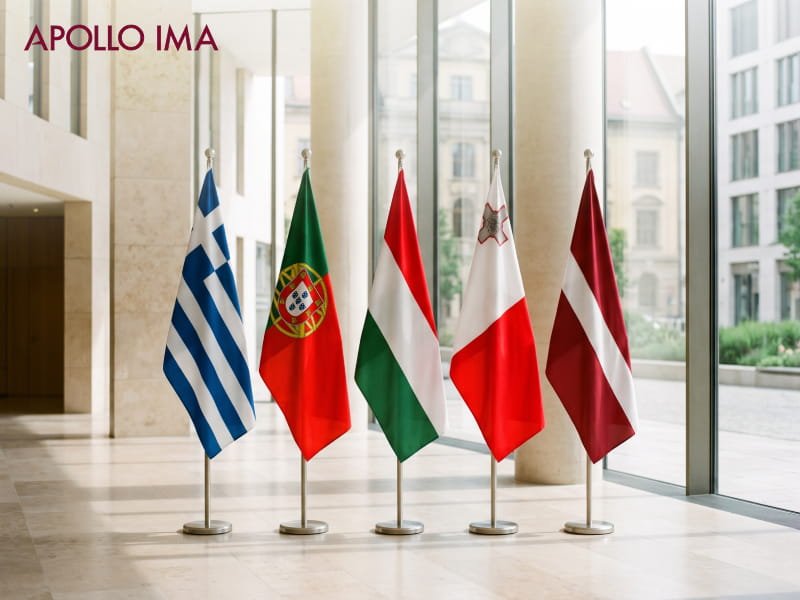
Greece
Greece is the most flexible choice for property buyers. Apollo IMA lists €800,000 for one residential property of at least 120 m² in Attica, Thessaloniki, Mykonos, Santorini, or islands with more than 3,100 residents, and €400,000 in other regions. The €250,000 level covers a commercial-to-residential conversion, a heritage restoration, or a 10-year hotel or tourism lease. Funds start at €350,000.
There is no mandatory stay, and processing runs about 12 months. Permits renew every five years while you hold the investment. The Greece golden visa lists citizenship eligibility after seven years of legal residence, with integration and language conditions.
Portugal
Portugal has no property route. The main options start at €500,000: a qualifying fund with a maturity of at least five years, a company that creates five jobs or keeps ten, or a research donation. A cultural donation starts at €250,000. In low population density areas, the research donation drops to €400,000 and the cultural donation to €200,000.
Apollo IMA lists 12 to 18 months of processing and a short stay requirement: 14 days across the first two years and 21 days across the next three. The Portugal golden visa page lists citizenship after five years, but the 2026 law may extend this to 10 years for most non-EU nationals. Check the current rule with your adviser.
Hungary
Hungary’s guest investor program starts at €250,000 in units of a licensed real estate fund. A donation route of €1,000,000 to a higher education institute also exists. The permit lasts 10 years from the day it is issued, which is long for an EU program.
There is no residence obligation, but you must keep the investment for at least five years. Apollo IMA lists processing of four to five months. The Hungary investor visa can lead to citizenship after eight years of legal residence. Family inclusion covers a spouse and children.
Malta
Malta offers permanent residence, not a temporary permit. Apollo IMA lists a minimum outlay of €169,000 on the lease route. That total includes a €37,000 contribution, a €2,000 donation to a registered charity, a €60,000 administration fee, and a five-year lease at €14,000 a year. Buying a property starts at €375,000.
You must also show either €500,000 in assets with at least €150,000 in liquid financial assets, or €650,000 in assets with at least €75,000 liquid. There is no minimum stay, and processing takes about eight months. The Malta permanent residence program is not a direct passport route. Apollo IMA lists eligibility to apply for naturalisation after five years of residence, through a separate process.
Latvia
Latvia is the cheapest on Apollo IMA’s list. Its business route starts at €50,000 in a Latvian company, plus a €10,000 government fee. Other routes include real estate from €250,000, bonds from €250,000, and a bank deposit of €280,000. Processing runs one to three months. Details are on the Latvia residence page.
Quick Comparison
| Country | Lowest entry | Processing | Stay requirement | Citizenship timeline |
| Greece | €250,000 | About 12 months | None | 7 years |
| Portugal | €200,000 (donation, low-density area); €500,000 (main routes) | 12–18 months | 14 days in 2 years, 21 days in next 3 | 5 years per Apollo IMA; 2026 law may extend to 10 |
| Hungary | €250,000 | 4–5 months | None | 8 years |
| Malta | €169,000 (lease route) | About 8 months | None | 5 years (separate naturalisation) |
| Latvia | €50,000 + €10,000 fee | 1–3 months | No minimum stay | 10 years |
Figures are from Apollo IMA’s program pages, last updated in October 2026. Confirm them before you commit.
Who Can Apply?
The main applicant must be at least 18 and hold a non-EU, non-EEA, and non-Swiss passport. You need a clean criminal record, a lawful source of funds, and in most programs, health insurance. Every adult goes through due diligence.
Family rules differ. Greece and Portugal cover a spouse, dependent children, and dependent parents. Hungary and Latvia cover a spouse and children. Malta goes further and allows up to four generations. Adult dependants often pay extra fees.

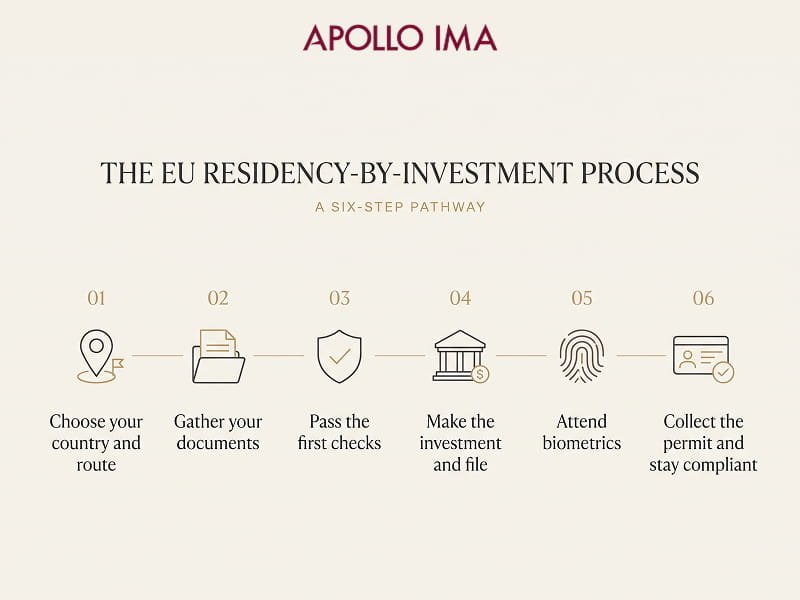
How the Process Works, Step by Step
Every country has its own forms, but the path looks much the same.
- Choose your country and route. Match the investment to your budget and goals.
- Gather your documents. Expect passports, police certificates, proof of source of funds, and bank statements. Foreign papers often need an apostille and a certified translation.
- Pass the first checks. Advisers and banks review your file before you move any money.
- Make the investment and file. In Greece and Portugal, funds must come from abroad. In Hungary, you first get a Visa D, then complete the investment within 93 days of submitting the residence application.
- Attend biometrics. You usually visit the country once to give fingerprints and a photo.
- Collect the permit and stay compliant. Keep the investment, renew on time, and meet any stay rules.
What It Really Costs
The entry amount is only part of the bill. Add government processing fees, due diligence charges, legal work, translations, and adviser fees. Malta’s €60,000 administration fee shows how large these costs can be.
Property routes add taxes and closing costs, plus upkeep while you hold the asset. Donation routes cost nothing to hold, but you cannot get that money back. Ask for a written quote before you sign, and check what it leaves out.
How Long Does It Take?
Timelines range from about one to three months in Latvia and four to five months in Hungary, up to 18 months in Portugal. Malta sits near eight months, and Greece near twelve. These are Apollo IMA’s listed figures, and real cases can run longer when documents arrive late or the authorities ask more questions.
You can save time. Order your police certificates early, use recent bank statements, and answer requests the same week they arrive.
Benefits and Limits
The main benefit is flexibility. You get legal residence in an EU state, Schengen travel, and the right to live, work, or study there. Most programs ask you to visit only a few days, or not at all.
But be clear on the limits. A permit is not a passport. It does not guarantee citizenship. Your investment can lose value, and rules can change before you apply for naturalisation.
Tax is another point. A permit does not move your tax residence by itself. Your days spent in each country, and your home country’s rules, decide that. Speak to a tax adviser first.

How to Choose the Right Program
Start with your goal. If you want a property you can own and rent, Greece or Malta fit best. If you want no property, look at Portugal’s funds or Hungary’s fund route. If speed matters, Hungary is the quickest of the four main programs, though Latvia processes in one to three months.
Then look at the long game. Greece lists citizenship eligibility after seven years, while Apollo IMA lists five years for Portugal and Malta, subject to each country’s current law. If you plan to apply, ask how time abroad counts. For a closer side-by-side, read Apollo IMA’s Greece vs Portugal golden visa comparison.
Final Thoughts
EU residency by investment still works in 2026, but the field is smaller and stricter. Greece, Portugal, Hungary, and Malta lead for most investors, and each suits a different goal. Entry costs for these four run from €169,000 to €500,000 and beyond, and timelines run from four to eighteen months. Latvia offers a lower entry point from €50,000.
Do not choose on price alone. Check the source-of-funds rules, the stay requirement, the citizenship timeline, and the total cost. Then act on clean paperwork, because weak files cause most delays.
Frequently Asked Questions
Q1) Is EU residency by investment still available in 2026?
Yes, in several countries. Greece, Portugal, Hungary, Malta, and Latvia still run programs. Spain closed its program in April 2025, and Ireland and the Netherlands closed theirs earlier.
Q2) What is the cheapest EU golden visa?
On Apollo IMA’s list, Latvia starts at €50,000 through a business route, plus a €10,000 fee. Malta’s minimum outlay is €169,000. Entry capital is not the full cost, so compare all fees.
Q3) Does a golden visa give me citizenship?
No. It gives residence. Citizenship needs a separate application after years of legal residence, and each country sets its own timeline and conditions.
Q4) Do I have to live in the country?
Usually no. Greece, Hungary, and Malta list no mandatory stay. Portugal asks for a short stay each period.
Q5) Can I include my family?
Yes, in most cases. Greece and Portugal cover a spouse, dependent children, and dependent parents. Hungary and Latvia cover a spouse and children, and Malta allows up to four generations. Fees can apply for adult dependants.
Q6) Can I buy property for an EU residence permit?
In Greece, yes. Malta also uses property, through a purchase or a lease. Latvia offers a real estate route from €250,000. Portugal no longer accepts real estate, and Hungary’s main route uses a real estate fund instead.